Monday, 3 October 2016

Walking with T S Eliot - The Waste Land - 'Unreal City'


To where St Mary Woolnoth kept the hours
With a dead sound on the final stroke of nine.
O City city, - how I love thee!  No this is not a line from The Waste Land, but I have taken liberties with a partial quote.

The City of London, his inspiration, whilst Mr Eliot worked at Lloyd's of London in the Foreign and Colonial Department off Lombard Street.  As much as his literary friends wanted to get him away for his job, he did in fact seem to enjoy it, Eliot found the science of money fascinating.  He also includes his work-a-day experiences in the poem too.

Mr Eugenides, the Smyrna merchant
Unshaven, with a pocket full of currants
C.i.f. London: documents at sight
Asked me in demotic French
To Luncheon at the Cannon Street Hotel
Followed by a week-end at the Metropole

Every line loaded of course with meaning, sex, trade off and business! However, as Eliot would have wanted, make of it what you will, as it conjures up an interesting picture in the imagination, whether you know anything about Smyrna, documents of lading or where these hotels may be located, let alone a Mr Eugenides!

As an American, having planned a short stay in Europe, arrives in London and never leaves (many of us are members of this particular club!) carried with him a Baedeker (travel guide books published by the Karl Baedeker firm of Germany beginning in the 1830s).  Eliot made notes in  various sections, including St Magnus the Martyr and St Mary Woolnoth. They are likely to have come to his attention through the document 'Proposed Demoliton of Nineteen City Churches, 1920, Vol.8 : Report by the Clerk of the Council and the Architect of the Council'.  If you like horror stories this will terrify you!

T S Eliot had spent many a quiet moment of contemplation in both churches, if not more on the list. He also wrote, in support of their survival in one of the quarterly literary magazines, the Dial,  of his contempt for such a proposal whereby these buildings gave the business centre a beauty - redeems hideous banks and commercial houses which have not quite defaced ... the least precious redeems some vulgar street. 

Both churches still have connections with The Waste Land today, one has a section of the poem displayed and the other possibly an inspiration for The Fire Sermon.

If you would like to know more about The Waste Land and its impact on T S Eliot join me on the walk during the Footprints of London Literary Festival which takes place anually in October.


For those of you who cannot make the walk you can listen to some of the highlights on the podcast at Londonist OutLoud, by interviewer N Quentin Woolf. 

http://londonist.com/podcasts/londonist-out-loud-the-waste-of-land


Review by Matt@Londonist:

With The Waste Land, TS Eliot sets his stall as the poet laureate of London. The modernist poem wraps itself through the city, like a hitch knot round an anchor. Scenes of London life and London lore abound. It is, perhaps, the only great poem that lends itself to a guided walk round the capital. 

Tina is the perfect guide. We dip in and out of churches, gardens and alleyways to discover the places and objects that inspired Eliot's masterpiece. The frequent readings, given on location, help us make sense of verse that can often seem challenging. It is a mesmerising two hours. Time well spent for anyone wanting to explore Eliot's greatest work, or simply to see the City through a new filter. On Thameside sands, our guide connects everything with everything.


Sunday, 2 October 2016

‘Victorians Decoded: Art and Telegraphy’ Exhibition Celebrates the 150th Anniversary of the Transatlantic Cable Connecting Europe with America


Guildhall Art Gallery, City of London, 20th September 2016 to 22nd January 2017

It has been a while since I visited the Guildhall Art Gallery and I am always enjoy this gem in the heart of the City of London. It is an interesting subject for an exhibition and also a good opportunity to delve into its huge Victorian collection, and show paintings not seen before, or for a very long time.


The magnificent paintings of the swells of the Atlantic waves ‘The Isles of the Seas’ (1894) Thomas Hope McLachlan (never displayed previously) certainly give you an idea of what these extraordinary, enterprising and determined Victorians were up against to run the first communications cable across the Atlantic Ocean, connecting Europe with America. It revolutionised connections between continents, messages took minutes, rather than mail which took weeks! Rightly so, this segment comes under the theme ‘Resistance’.

The exhibition is themed as Distance, Resistance, Transmission and Coding and leads you through the story of laying the heavy cables across the ocean floor from Valentia Island in Ireland to Newfoundland in Canada. It took nine years and four attempts to change communications forever.

The paintings are depict the natural elements that this engineering feat was up against, just take a look at Edwin Landseer’s ‘Man Proposes, God Disposes’ (1864) this visceral painting of polar bears, raw in tooth and claw, foraging among the remains of a wreck in frozen wastes, an image of what might be your fate.


Also included is Tissot’s ‘The Last Evening’  which might allude to lack of communication, different messages passing between beholder and viewer. Perhaps it would be easier for the group to send messages to one another than talk? Moving onwards to physical coding, written in a form to shorten messages and hide content, operators used code books and ciphers. The looks and actions of this disparate group is all codes and ciphers!


Plus ‘transmission’ alluded to in the painting of a plague victim, by making contact with a sick person one might meet a similar fate to the great explorers, survival or death, to go or to stay? This was one of the connections I found rather hard to understand initially, but acknowledge it now.

There is are an interesting collection of artefacts including huge ‘batteries’ and ticker tape machines, as well as code books. A particular favourites item looks, and indeed feels like a Victorian invention, but is in fact brand new, a creation of UCL PhD student Alexandra Bridarolli.


A fascinating box, inspired by ‘The Grand Automatic Grammatizator’ a story by Roald Dahl (1953). An interactive messaging machine that will produce personal ‘coded’ poems for the public to enjoy. Rotating buttons offer you choices and a lever is cranked to produce a slip of paper with a poem just for you.  There is also a code to decipher, using one of the secret code books in the display cabinet.


The exhibition is unusual and enticing, with something for all, especially ‘telegraphy’ boffins. As wells as the discerning engineer and inventor, the art lover, history researcher and for anyone in communications this is a must.  Communications as we know it today, from banks monitoring shares to mobile phones, it all began with the telegraph and the laying of cable, and I am sure there was someone who said ‘This will never catch on!’ or they will not succeed!  Succeed they did against adversity and this exhibition goes some way to explore and celebrate it! See my special message to you below, happy decoding!

.  _.  ._ _ _  _ _ _  _._ _   _._ _  _ _ _  .._  ._.  ..._  .. ... ..  _


More information: https://www.cityoflondon.gov.uk/things-to-do/visit-the-city/attractions/guildhall-galleries/Pages/victorians-decoded.aspx

Saturday, 14 May 2016

An old idea with a new twist - Elevated Walkways!

Artist's Impression of the proposed green space at St Alphage.
The City of London Pedway Scheme was a plan to transform traffic flows in the City of London by separating pedestrians from street level traffic using elevated walkways. First devised as part of the post World War II reconstruction plans for London, it was put into effect mainly from the mid-1950s to the mid-1960s and eventually abandoned by the 1980s.  See Vimeo link for film 'The Pedway - Elevating London'  https://vimeo.com/80787092

After World War II, during which London had suffered severe bomb damage. Enthusiasts for the scheme saw an opportunity to put it into practice through the post-war reconstruction programme, and in 1947 architect Charles Holden and planner William Holford developed a blueprint that envisaged a network of first-floor walkways that would connect buildings across the City.
By the mid-1960s, the City of London Corporation had incorporated the scheme into its development plan. Although no coherent network was ever defined, designers of new developments were required to incorporate first-floor access to the Pedway network as a condition of being granted planning consent. As most of the network had not been built, this meant that many developments incorporated wwith first-floor level and partial walkways that led to dead ends. In consequence, the scheme was unpopular with many architects.
By the mid-1980s, the scheme had effectively been discontinued. The Pedway scheme only succeeded in establishing itself in areas that required extensive post-war reconstruction. The most extensive part of the network to be completed was in the Barbican Estate and surrounding streets; the main entrance to the Museum of London is, to this day, at first-floor level.
The recently demolished pedways around Fore Street and St Alphage, although long-deserted in terms of commercial activity, were always useful and a pleasant alternative above the traffic of London Wall. We now know that the new development by Brookland includes a modern version of the pedway in the new build as well as extensive landscaping. Including the enhancement of and redesign of St Alphage Gardens. The David Hicks designed Salterers Garden will also be refreshed. The Salterers Hall by Basil Spence is dazzling after a recent makeover. 
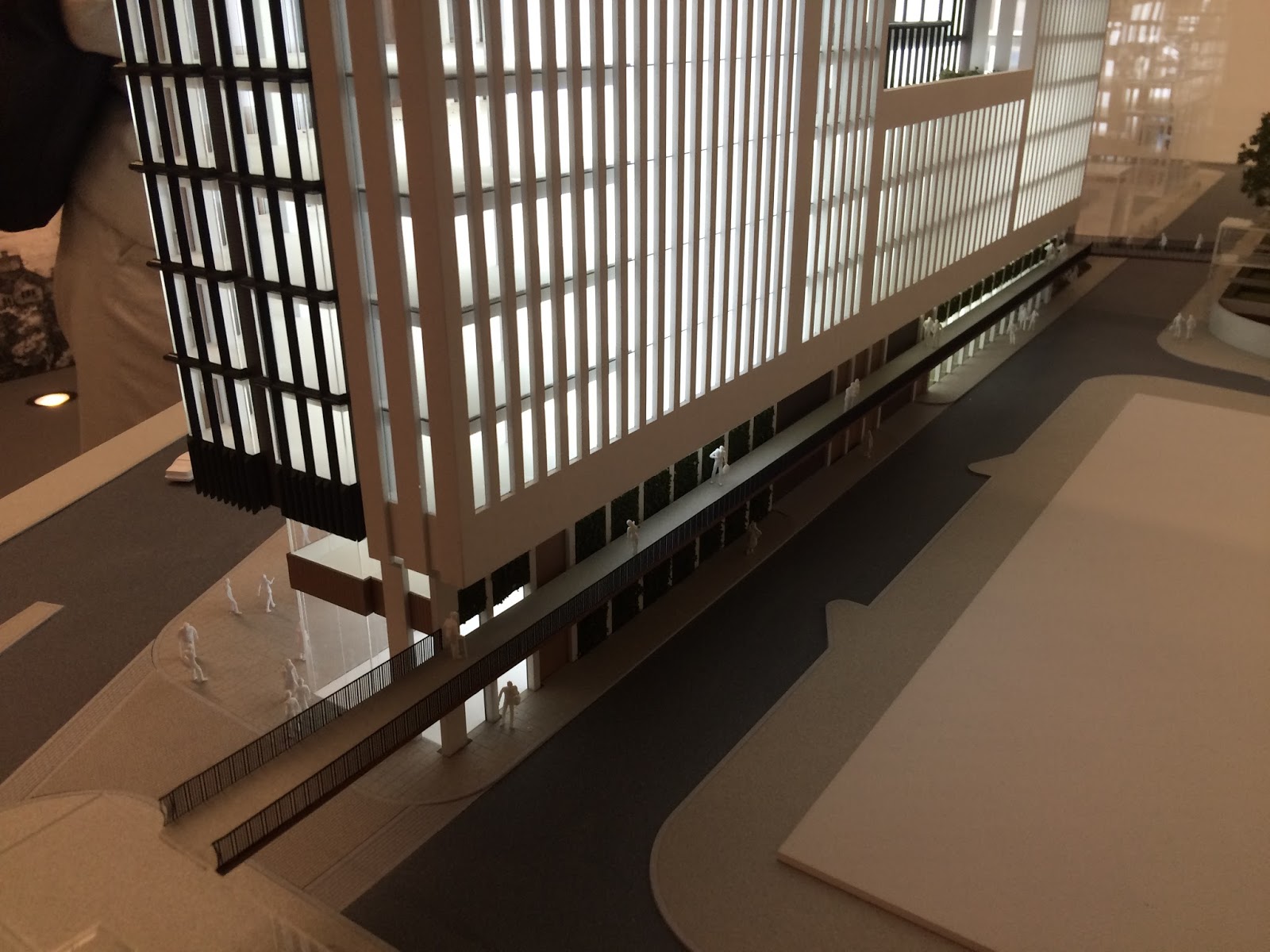
A model is currently on display of London Wall Place (view by appointment) at the The City Centre, 80 Basinghall Street EC2V 5AR, and shows the new elevated walkways ('pedways') at London Wall with an interesting meander which will incorporate a 'green wall'.  Although the new building will block views from various points, the plus side is the pedways will be making a comeback and we can walk from Wood Street also from Aldermanbury Square, above ground, and work our way towards Moorgate above the traffic again! There is also a link back to the Barbican at Alban Gate.
Here are some pictures of the model.  I will leave you to have fun working out where they all lead to.


The ruins and Salterers Hall beyond - the meander! 

This joins the Barbican above 125 London Wall.

A garden wall will cascade from this - St Alphage is on the right.

Leading across London Wall towards Brewers Hall


See the Gallery at Brooklands web site: http://www.londonwallplace.com/gallery/
The City Centre is worth a visit expecially for the wonderful model of the City Model. There are is some film to view as well as an exhibiton 'The City Garden' created by artist Rebecca Louise Law - installation of natural materials inspired by the gardens within the City, ends 25th September 2016.
Opening Times : The City Centre Gallery : Mon-Sat 10.00-17.00 
The City Model & Exhibition: Fri-Sat 10.00-17.00