Wednesday, 9 November 2016

City's Police Museum - new venue opened this week!


Have you heard of the ‘The Houndsditch Murders’? Claimed the lives of three City of London Police officers and remains to this day the largest loss of life in one incident on duty in the UK! Check out the model of the building where the murders took place which was used at the trial. Plus a 3D animation of the original automatic Mauser pistols – a lethal weapon!

So where can you find all this and more? Make your way to the new City’s Police Museum housed in the Guildhall Library which opened on 7th November.

In the beginning ...

It is a small space, but like Dr Who's tardis, once entered it seems much bigger! Brilliantly designed and decorated with excellent graphics, large bright show cases, 3D elements and all on a tight budget.  The Heritage Lottery Fund awarded a grant of £90,000 towards the development of the museum and associated community engagement. Success of the project is not only down to the team of staff and volunteers at City of London Police and the Guildhall Library, but working in partnership with Guildhall School of Music & Drama, and the City of London Corporation (who owns the school). Plus the City Guides who helped promote the Police Open Day and who we hope will play an important role in encouraging visitors to go to the Museum.

City of London badge on early uniform

The Museum also offers tours to schools, so do check the web site for further details of tours, plus walks and talks.

My admiration is of course biased as I am a City Guide and very proud of the City and all those mentioned above to create from a large, dare I say, disorganised, collection of historical records and many macabre artefacts, this very modern and elegant little museum.  I was like a kid in a sweet shop when I was invited to the private view.  My photographs only give a taster, you must visit to really appreciate why I am so excited about it.


Not to give too much away, I am only offering headlines here of what you will find:

Catherine Eddowes – last victim of the Ripper

The Hounditch Murders – as mentioned above

The recruitment of women into the force

The Two World Wars and their impact on policing

Olympic Gold Medal – won in 1920 – City of London Police are still the reigning champions


Terrorism – from the home-made bombs by the suffragettes on display

Technological progress of communications

Police Uniforms and kit

The force’s animals

There is something of interest for everyone and hands on too! 


City of London Police Commissioner Ian Dyson said:

 “We are a unique force and everyone who works here is incredibly proud to serve the City. This museum illustrates much of what makes us special, our partnerships, our close links to our communities and most significantly, a long history that entwines us with the Square Mile and London.” Sara Pink, Head of the City of London Corporation’s Guildhall Library and City Business Library, said: “The museum will certainly attract a wide range of visitors, including City workers, residents, tourists and crime historians. From the horrors of Jack the Ripper’s murders in Whitechapel to how all of us must be extra-vigilant about identity fraud and terrorism, the exhibits will bring the personal stories and issues alive.”

The Commissioner mentioned 'Z Cars' in his speech at the Private View, and those of who remember the TV series can no doubt still hum the theme tune.  Just in case you have forgotten here is a You Tube link:https://www.youtube.com/watch?v=rWflrCrwUSw .


Sara Pink, Head of the City of London Corporation’s Guildhall Library and City Business Library, said:

“The museum will certainly attract a wide range of visitors, including City workers, residents, tourists and crime historians. From the horrors of Jack the Ripper’s murders in Whitechapel to how all of us must be extra-vigilant about identity fraud and terrorism, the exhibits will bring the personal stories and issues alive.”


Admission is FREE
Details of opening times can be found here:


For those of my readers who are not City local, the information below explains something of the workings and connections of and with the City of London:

About the City of London Corporation:
The City of London Corporation is a uniquely diverse organisation. It supports and promotes the City as a world leader in international finance and business services and provides local services and policing for those working in, living in, and visiting the Square Mile. It also provides valued services to London and the nation. These include the Barbican Centre, Barbican Music Library, Guildhall School of Music & Drama, Guildhall Library, Guildhall Art Gallery and Roman Amphitheatre, London Metropolitan Archives, a range of education provision (including three City Academies); five Thames bridges (including Tower Bridge and Millennium Bridge), Central Criminal Court at Old Bailey, over 10,000 acres of open spaces (including Hampstead Heath and Epping Forest), and three wholesale food markets. The City of London Corporation is London’s Port Health Authority and also runs the Animal Reception Centre at Heathrow. For more details, visit www.cityoflondon.gov.uk

About the City of London Police:
The City of London Police is responsible for policing the City’s business district, the ‘Square Mile’ in the historical centre of London.  In addition, it holds national responsibility for Economic Crime and under this remit is host to Action Fraud (the national fraud and cybercrime reporting service), the National Fraud Intelligence Bureau, the Insurance Fraud Enforcement Department and the Police Intellectual Property Crime Unit. The City of London continues to be one of the safest urban areas in the country.

About the Guildhall School of Music & Drama
The Guildhall School is a vibrant, international community of young musicians, actors and theatre technicians in the heart of the City of London. Twice-rated No.1 specialist institution in the UK by the Guardian University Guide, and recently selected as one of the top ten institutions for performing arts in the world (QS World University Rankings 2016), the School is a global leader of creative and professional practice which promotes innovation, experiment and research, with over 900 students in higher education, drawn from nearly 60 countries around the world. It is also the UK’s leading provider of specialist music training at the under-18 level with nearly 2,500 students in Junior Guildhall and Centre for Young Musicians. The School is widely recognised for the quality of its teaching and its graduates, and its new building, Milton Court which opened in September 2013, offers state-of-the-art facilities to match the talent within its walls, ensuring that students enter their chosen profession at the highest level. Milton Court is part of the unique Guildhall School/Barbican partnership delivering world-class arts and learning.

About the Heritage Lottery Fund:
Thanks to National Lottery players, we invest money to help people across the UK explore, enjoy and protect the heritage they care about - from the archaeology under our feet to the historic parks and buildings that we love, from precious memories and collections to rare wildlife. www.hlf.org.uk @heritagelottery

Tuesday, 8 November 2016

The Queen's House - ‘jewel in the crown’


of the Museum and the Maritime Greenwich World Heritage Site.


A chilly but sunny day brought me by MBNA Clipper to Greenwich, how else would you travel except by boat to the famous naval college and museum? However, my appointment was with the London Historians team to visit the recently opened Queen’s House.

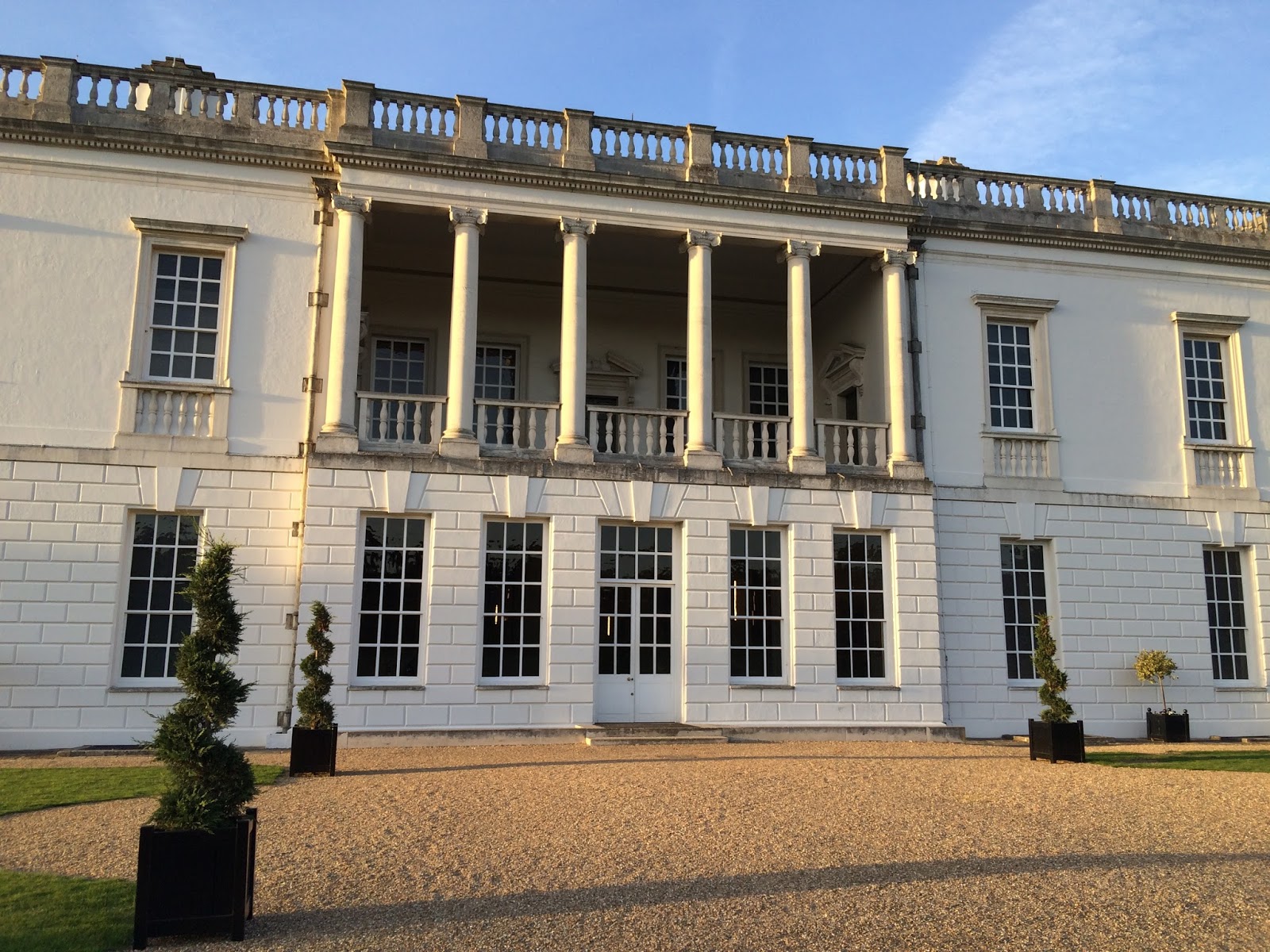
The Inigo Jones designed house was the first great classical building of its kind and the last part of what was the great Tudor Palace of Greenwich as created by Henry VIII on a site of a Palace built by his father Henry VII. It was also the home of his son and then his daughter, Elizabeth I.

The manor of Greenwich was gifted by James I to his Danish queen, Anne, apparently as an apology for losing his temper after she accidentally shot one of his hunting dogs whilst on the hunt. It was Queen Anne who employed Inigo Jones to design and build what was initially a house within garden retreat. The front is in fact the back and the views from here look across the park up the hill, where the Observatory is now. Interestingly, the Greenwich to Woolwich Road ran behind (the front of the house) and in fact the later additions, the colonnades follow the line of the then road.  Queen Anne never saw the house completed this was left to the wife of Charles I, Queen Henrietta Marie.  When it was finished in 1638, it became her building of choice for her Court.


There is much to be said about the history before James I's reign and there is much to be said about the history after the house became part of the Greenwich Naval College. Please note, the later specific siting of which, was to ensure the view from the Queen’s House would be clear sight line to the Thames.

There is a book on sale at the National Maritime Museum (just next door for those not in the know) at a reduced price called The Queen’s House Greenwich’ by Pieter van der Merwe, who was our guide on my first visit. The book is gem and a bargain!

Into the Queen’s House we go via a door in what were the foundation vaults with no access to the piano mobile.  A mound of soil would have been banked up against it and grassed over. A plain set of steps up one level brought us to the Tulip Stairs, apparently one of the most photographed stairwells in the country if not the world! From the book - ‘This is the earliest centrally unsupported spiral stair in England, on the Italian Renaissance model’. It was designed as a descending flight so one might make a grand entrance in to the Hall.  A point of interest are the flowers in the design are which are lilies, the royal flower of France and incorporated as a compliment to Henrietta Maria. So why ‘tulips’? The wrought-iron rail design was first called this in an account for a smith’s repairs in 1694, he was probably unaware of their significance.


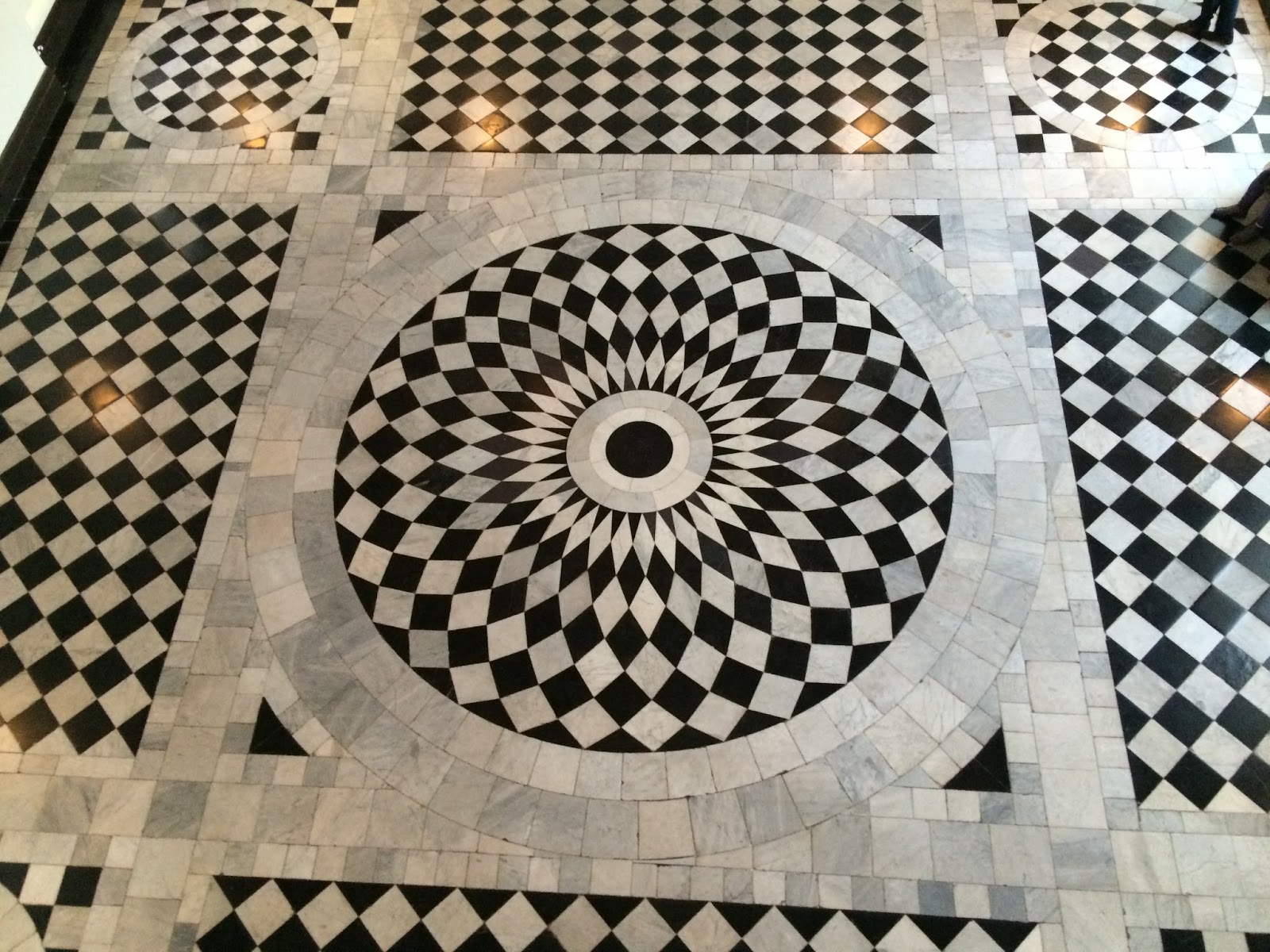
The Hall is ‘nominally a 40-foot cube but not precisely’ due to construction adjustment, but beautiful it is. A bright room with a floor of Italian marble, with a wooden gallery, which still shows some of Jones’s original paint scheme of white and gold. What is also golden is the detail on the walls and ceiling, one might think it is a schematic from an earlier period but in fact it is a contemporary design, by the Turner Prize winner, Richard Wright.  I viewed the gold-leaf fresco for the first time with the sun pouring in through the tall windows, on closer inspection on the gallery and looking up you begin to see the patterns forming, a perspective appearing and then reforming again. The gilt flowers, inspired by the tulips, or lilies of the staircase are mesmerizing. 


On my second visit on a grey cold day, found them even more fascinating as I could see even more iridescent shimmer in the pattern. A lovely inspired addition after some 400 years.


The Queen’s House has more rooms than you would imagine, extravagant ceiling painting, art by many a great master, including a Lowry, many dead Admirals, not surprising really. A family-tree of Tudors all in a row. As well as the Armada Portrait which has recently been saved for the Nation by the Nation!


I have been twice and plan to go again as each time I see something new, and can revisit my favourite areas. There are also several anterooms which showcase the wide-ranging objects and painting subjects in the huge collection of the Royal Museums Greenwich.


William de Morgan

The drawings of plants and flowers from the brave botanists who sailed with Captain Cook, You will find Emma Hamilton and Lord Nelsondisplayed with a bust of their daughter Horatia. The position shows how like her father she was.

The Nelson Family

Display of instruments to guide the seafarers and landlubbers, such as the Astrolabe (a blog to follow).  Last but not least, the room with the drawings of Indigo Jones, particularly the sketch for a ceiling painting, the perspective draws you in.  There is some fine photography too. Something for everyone I would venture to say.

Inigo Jones Sketch for a ceiling decoration

I will leave you to find your own favourites, it is an intense couple of hours, I shall return soon to explore again the very fine Queen’s House.

Note the laughing Unicorn!

Entrance to The Queen's House is free.

You may also like to visit the fabulous SEDUCTION & CELEBRITY: Life and Times of Emma Hamilton which is showing next door at the National Maritime Museum.


Wednesday, 12 October 2016

A Walk with Mr Eliot in Margate - 8th October 2016


T S Eliot's View - Margate

On Margate Sands
I can connect
Nothing with nothing

               III Fire Sermon – The Waste Land

On one of the hottest days of the year I took several members of “A Journey with The Waste Land Research Forum” for a walk in the City of London, introducing them to the ‘psycho-geography’ that influenced T S Eliot when writing The Wasteland (pub. 1923 Hogarth Press).

The group came all the way from Margate and were having a grand day out organised by the Curator and Research Curator of the Turner Contemporary for the project, which will see the Margate community create an exhibition influenced by Eliot’s great poem, due to open 2018.

In turn I was invited to join the “Fallen Leaves Festival” on the 8th October in Margate to ‘talk my walk’ T S Eliot in the City, as a walking book. The outing included site readings of “Burnt Norton” we set out from the Turner Contemporary to The Garden Gate, more of this later. The walk was to make connections with rhythm, rhyme, memory and walking.


We met in the foyer of the Turner Contemporary, I will be writing about the gallery in more detail in a separate blog, introductions were made and each walking book introduced themselves and their subject, and we were:

‘A Journey with The Waste Land’
Trish Scott
Trish Scott is the Research Curator at Turner Contemporary, and is working with 30 volunteers to co-curate the gallery's first major exhibition of 2018, A Journey with The Waste Land, which explores the connections between T.S Eliot's poem The Waste Land, partly written in Margate, and the visual arts.

‘Shoulder to Shoulder – tales of the Broadstairs Town Shed’
Claire Shelton
I have been involved with the Shed project since 2014. I’m project manager, fund raiser, community liaison, and day to day co-ordinator. http://www.broadstairstownshed.org.uk/

‘Experiential Research, Materials and Spaces’
Catherine Richardson
With an art college background, followed by studies in literature and medieval and early modern culture and society, I work on the history of material culture – how the physical world shaped and was shaped by people’s actions, interests and beliefs. There is more about all of this here: www.kent.ac.uk/english/sta ff/richardson.html

‘Here, There, Now and Then: Seeking the Self Through Space, Place, Time and Tides’
Louisa Love
Louisa Love is a Kent-based contemporary artist operating across sculpture, film, writing, research, walking, organisation and social/collaborative activity. She is interested in the nature and pluralities of artistic production, exploring the complex relationships between things, thoughts, knowledges and different modes of doing as a consideration of identity and the negotiation of self within the contemporary world. Experimental processes of drift and psycho-geography often inform her work. www.louisa-love.com  www.dadonline.eu

‘The Art of Walking’
Sonia Overall
Sonia Overall writes fiction and poetry. She has a strong interest in psycho-geography and site-specific writing, form, intertextuality and performance-based approaches to text. Sonia has written and abridged work for street theatre and has published two novels, A Likeness and The Realm of Shells (HarperPerennial) and a chapbook of poetry, The Art of Walking (Shearsman).
www.women-who-walk.org #soniaoverall   #womenwhowalknet

Plus All The Leaves Are Brown/Cliftonville Dreamin'
Julia Riddiough - Margate based artist with an active interest in exploring and investigating the archive, looking at the space between fact and the fiction. www.abrooksart.com and juliariddiough.com


The organiser Elspeth Penfold, designated the first people to join a walking book, thereafter seek your walking book.I was able to talk to at least eight people in the group, by changing my companion after one or more stops. We were also presented with a ‘spiral of rope’ an ancient Inca ritual of unknown origin, whereby you would knot it enroute as your mood took you.  I used mine as a badge on my sleeve and put in one knot to acknowledge the whole experience.

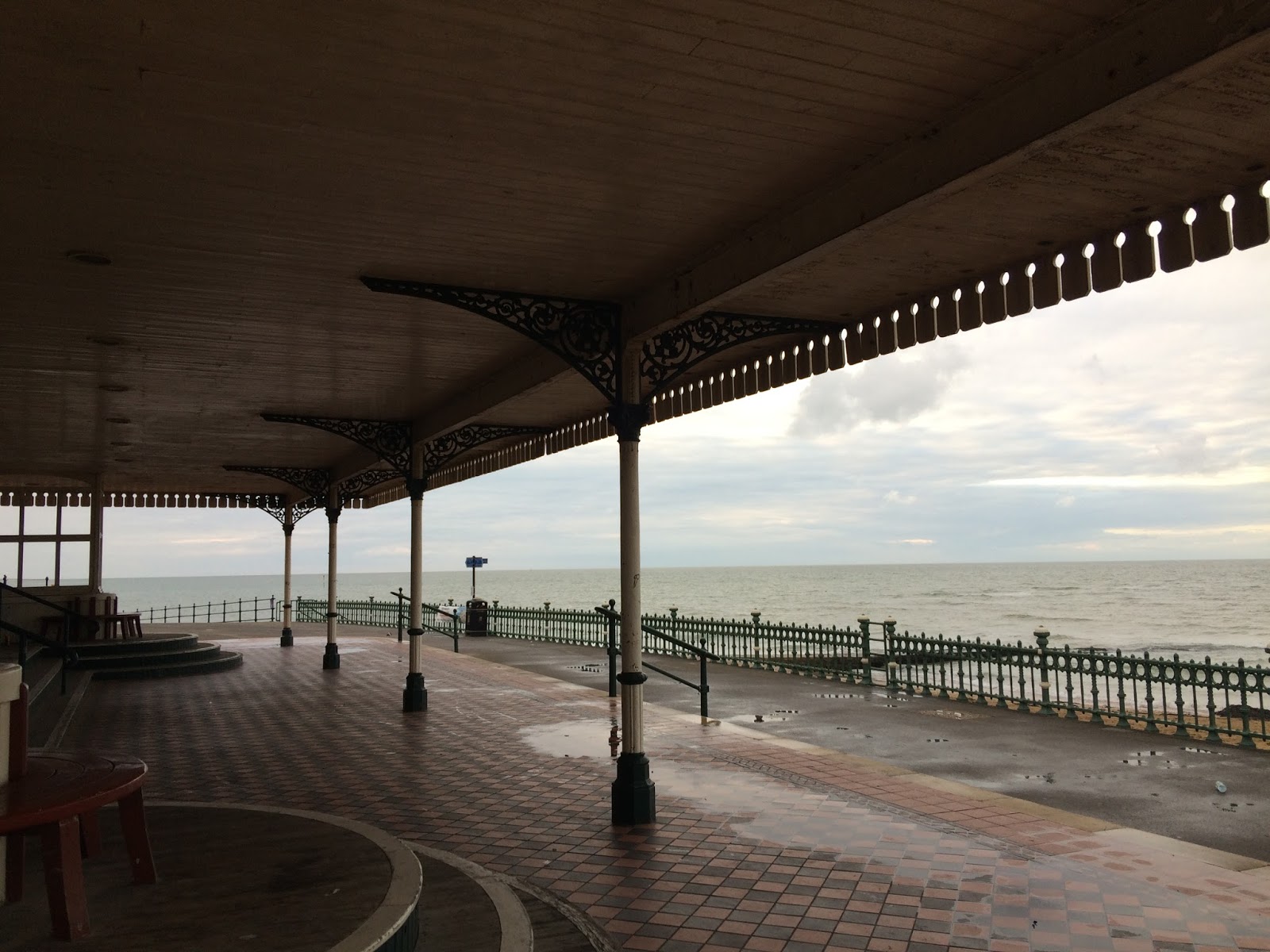
As we set off the heavens opened, umbrellas were at the ready, and remember these folk live on the Isle of Thanet and know about the changing weather on the coast, so dressed appropriately!  We set of in a westward direction, which was great for me as I had explored most of the beach in front of the town.  We headed for Fulsam Rock by the Fort Lower Promenade our destination Northdown Park.


I do not think anyone really noticed the rain and eventually it eased off. I enjoyed the readings and especially the talks with my walking audience, several of which had not yet read the The Waste Land, which was an interesting situation to overcome. I focussed initially on some of the City landmarks, London Bridge, St Magnus the Martyr and St Mary Woolnoth. Why he might have been drawn to them. The churches particularly were in the news at the time of his composing the poem, due to be demolished, he wrote of their enhancing the cityscape. Also London Bridge the conduit between home and work, life and death, hope and despair, and Eliot often mentions the ‘Sweet Thames’, not only in terms of ancient lore but this also connects him with the great river he grew up close to in his home town of St Louis.

‘Depressing and hopeless’ were words oft used to describe the poem.  I asked my companions to perhaps look at the poem in another way, for instance to reflect more on the construction of the poem, its staccato lines, followed by episodic, illustrative stanzas, as well as the dialogue and monologues, rather than hang on every word. Or view it in all its modernity, it was way ahead of its time, enjoy its complex fabrication, a collage made of words. Also there is no need to understand every word of it, that is not what Eliot would have wanted. Function over form, ‘feel’ the poetry rather than try to comprehend it. Let it feed your own imagination and emotions.


It has been a long time since I had no idea where I was going or the end stop, so it was a refreshing and relaxing few hours just following the group, along the beach, up stairways, through cliffs, along roads until we reached a library.  The grand finale was a delightful poem first conceived by the poet Keith Grossman when he was nine, and somewhat troubled. You can read it in full here :

We then met with the Garden Manager, Paul Boyce of The Garden Gate, who we followed to a ‘secret’ garden created by the community to enjoy gardening at their own pace, Monday to Friday.  At the weekends the site is open to events and fundraisers. A beautiful place which includes a welcome cup of coffee and on this occasion delicious pizza fresh from the outdoor oven. Highly recommend a visit.


So ended an eventful afternoon, made new friends and experienced new places, after a short bus ride we ended where we started at the Turner Contemporary. By chance met up with more of the Forum who had been to a talk in one of the galleries. They kindly invited me to join them for a coffee and creative chat.

So I came full circle …

In my beginning is my end, in my end is my beginning.

                                                                                The Waste Land, T S Eliot